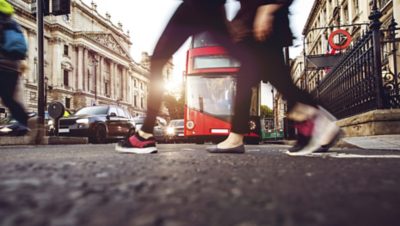
On London’s narrow streets, delivery vans, trucks, the city’s iconic black cabs and red double-decker buses fill the roads each morning, alongside pedestrians and the city’s growing fleet of cyclists.
With so many people and vehicles jostling for limited road space, the risks of collisions run high. The mix of trucks, cyclists and pedestrians has proved particularly risky.
Over the past three years, heavy-goods vehicles have been involved in 20 per cent of pedestrian fatalities and more than 70 per cent of cyclist fatalities in London. This is despite making up only four per cent of road miles driven in the city, according to statistics from the city’s transport authority, Transport for London.
Under the proposal, all heavy-goods vehicles over 12 tonnes will need a safety permit to operate in London from 2020.
The scheme is still under consultation, explains Will Norman. But as it is designed, a permit to enter London would be issued to heavy-goods vehicles that meet the minimum requirements for direct vision or can show equivalent measures to reduce risks to vulnerable road users. The final proposal is set to include specifications such as sensors and visual warnings.
“We are working to make our streets safer but we need haulage companies to improve the safety of their fleet,” says Will Norman.
Volvo Trucks has been following the developments in London closely.
“We applaud the effort being made in London to ensure traffic safety inside the city and protect vulnerable road users by joint efforts between different parties,” says Claes Avedal, Safety Manager Product Planning at Volvo Trucks.
We are working to make our streets safer but we need haulage companies to improve the safety of their fleet.
“So many factors – from vehicle design, to route planning, traffic awareness and street design – all play a role in making the interactions between trucks and vulnerable roads users safer,” says Claes Avedal.
Volvo Trucks also takes a multi-faceted approach to safety. It extends from areas such as safety research, to developing safety technologies including Lane Keeping Support and Advanced Emergency Brake, to designing safer vehicles and driver training. Traffic awareness campaigns such as ‘Stop Look Wave’ and the ‘See and be seen’ initiative are also a big part of this work.
City safety is now high on the political agenda in many places, so expect to see big changes around the world.
By 2041, Transport for London aims to have zero serious accidents or fatalities on its roads and that 80 per cent of all Londoners’ trips be made on foot, by cycle or using public transport.
“We can expect to see more change in cities around the world soon,” says Claes Avedal. “At Volvo Trucks we share London’s vision to eliminate accidents. Road safety in cities has lagged behind other areas. But city safety is now high on the political agenda in many places, so expect to see big changes around the world.”
London is leading the way.
Volvo Trucks Accident Research Team has studied and analysed more than 1,700 accidents involving trucks since 1969. It aims to increase the understanding of traffic safety and provide guidance in prioritising future development of road safety measures.
The number of fatalities in heavy-goods vehicle (HGV) accidents totalled 3,863 in the EU in 2014.
13%
499 fatalities
Accidents causing fatalities to HGV occupants.
49%
1,898 fatalities
Accidents causing fatalities to car occupants.
32%
1,230 fatalities
Accidents causing fatalities to vulnerable road users (VRU).
6%
236 other HGV-related fatalities.
Of the 1,230 VRU fatalities (in the EU 2014) 53% involved pedestrians,
22% involved cyclists and 25% involved moped riders or motorcyclists.
Accidents causing fatalities or severe injuries to vulnerable road users in the EU in 2014.
20%
Involve an HGV making a turn.
30%
Crossing accidents.
Three important considerations for truck customers to improve city safety and visibility from Claes Avedal, Safety Manager Product Planning at Volvo Trucks.
Plan the route
“Plan safe entry and exit points from busy work sites, the vehicle’s route through the city to avoid overly busy or narrow roads and for interactions with vulnerable road users. Planning can make all the difference.”
The right vehicle for the assignment
“Many customers want a truck that is as flexible as possible. That may mean that they choose a high chassis, even if their assignments are mainly in the city. But with a lower chassis, the driver is closer to the ground and has a better view of what’s happening around the vehicle.”
Camera and lower door window give you extended view
“It’s possible to see the entire front and side of the vehicle using only windows and the mirrors. However, the option of a corner camera and the lower window in the passenger door gives the driver extended view, which can prevent collisions when the truck is making a turn.”